

You do not need Google Tag Manager
That sounds bold, so let us qualify it right away: Google Tag Manager works fine. It is free, everyone knows it, and it is often already in place. But there is an uncomfortable side to it. To decide whether a tag may fire, you first route every visitor’s consent choice through American infrastructure. For a public sector organisation, and really for anyone who takes the GDPR seriously, that is hard to justify. In this guide we show how to switch to a tag manager without Google: Consent Studio Launcher.
Why move away from Google Tag Manager?
The problem with Google Tag Manager is not that it works badly. The problem is architectural. Your consent management platform often runs as a tag inside Google Tag Manager. That means your visitors’ consent signals pass through American systems before your site acts on them. Since Schrems II, that transfer to the US is legally vulnerable whenever appropriate safeguards are missing, and an “EU region” owned by an American parent company does not solve that.
There is a second, more practical objection: in most setups, consent was bolted on afterwards. The tag manager was designed first, consent was built around it later. You notice it in the user experience, in the mental model, and in the way things go wrong: tags firing when they should not, or the other way around.
What is Consent Studio Launcher?
Launcher is the built-in tag manager of Consent Studio and runs client-side, in your visitor’s browser. It is the place where you manage the scripts that make your website measurable and findable: from Google Analytics 4 and Matomo to the Meta Pixel, the Reddit Pixel and Microsoft Clarity.
The difference with a separate tag manager comes down to one word: consent-aware. Every tag knows which cookies it sets, which consent category it needs and when it may fire. Consent and tag firing live in the same interface, use the same categories and share the same testing tools. If a visitor says “yes” to statistics, your analytics tag fires. If they say no, nothing that requires consent fires. No glue code, no extra vendor in between, and (this is the point) nothing leaves European infrastructure just to decide whether a tag may load.
There is nothing extra to pay: Launcher is included in every Consent Studio subscription, from 10 euros per month.
A Google Tag Manager alternative in six steps
The switch is very doable, provided you work methodically. The outline looks like this.
Step 1: take stock of your current tags
Go through your Google Tag Manager container and note for each tag: which script it is, which trigger it uses and which consent category it should fall under (functional, statistics, marketing). This is also a good moment to clean up dead or duplicate tags.
Step 2: set up Consent Studio
Register your domain in the Consent Studio dashboard and place the Launcher snippet from the dashboard in the <head> of your site. That is the entire installation: one script that loads the cookie banner and the tag manager together.
Two properties of that snippet are worth mentioning. First, it sets the Google Consent Mode defaults to “denied” before anything else loads, so tags that require consent can never fire too early. Second, the script fetches its configuration based on your domain name, so the same snippet works on every environment you register in the dashboard, from test domain to production. A tip from our own implementation: make loading the snippet configurable in your site (a single on/off flag in your configuration), so you can switch the CMP on or off per environment without touching code.
Step 3: rebuild your tags in Launcher
Open Launcher’s template gallery; the familiar integrations (GA4, Matomo, Meta Pixel, Reddit Pixel, Clarity and more) are available out of the box. Add the matching template for each tag and enter your own configuration. What you need per tag is the same information as in Google Tag Manager: for an analytics tag the measurement ID or property ID and your measurement server endpoint, for an advertising pixel the pixel ID from the advertising platform. Scripts that are not in the gallery can be added as custom tags.
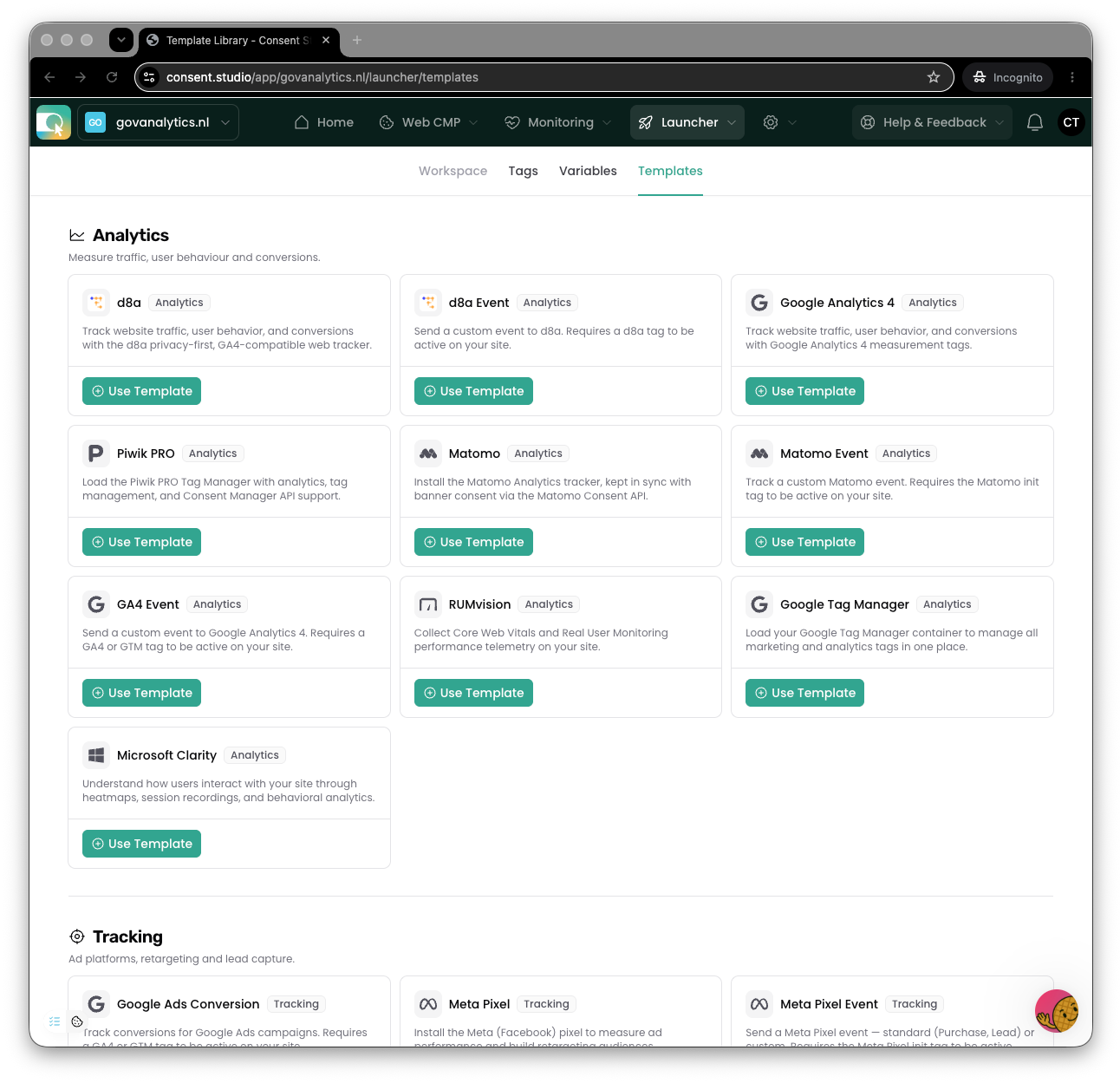
Step 4: assign each tag to the right consent category
Because Launcher is consent-aware, you simply assign the category; Launcher handles the gating itself. No separate triggers, blocking rules or custom events like in Google Tag Manager.
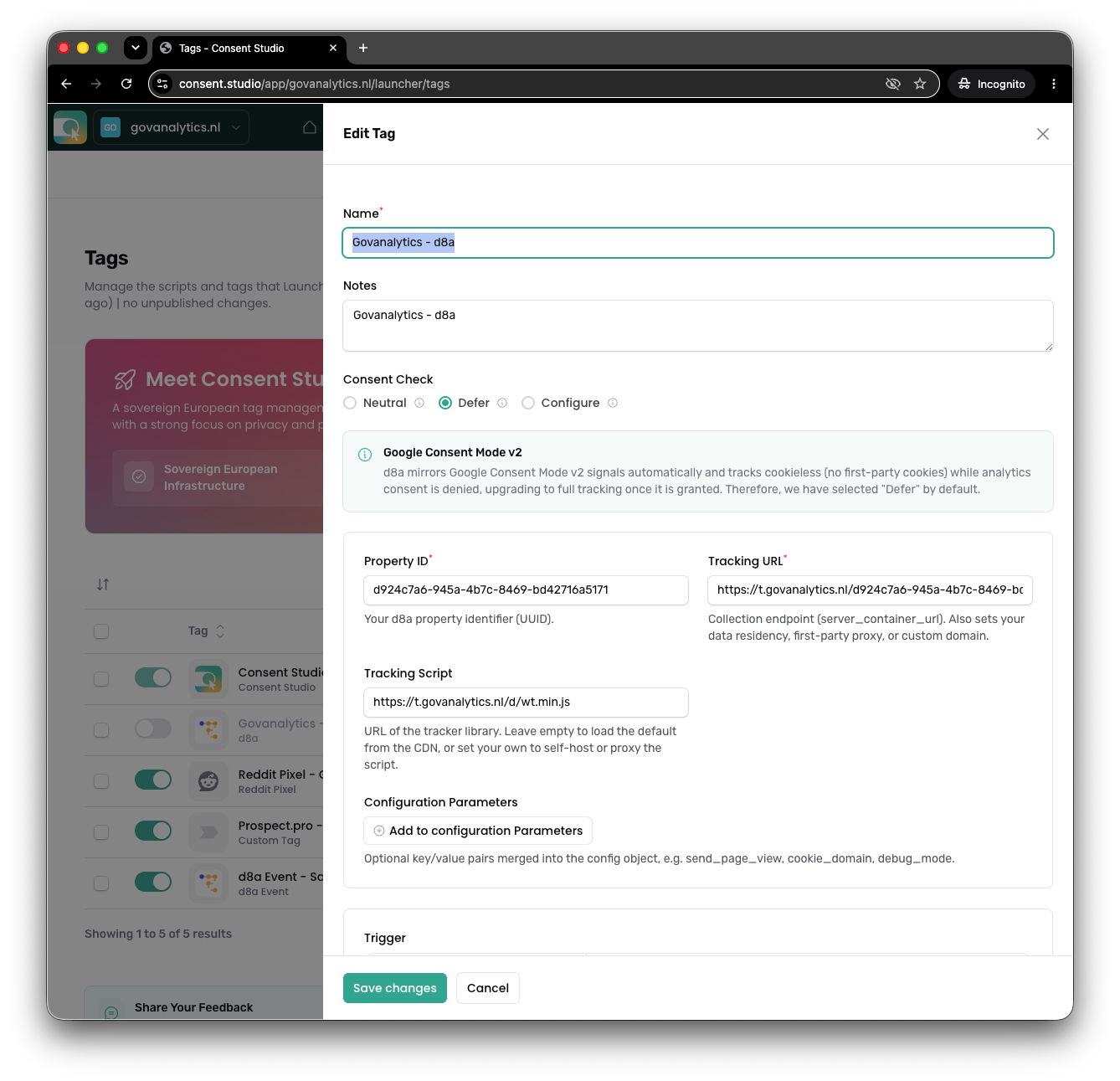
One nuance that actually makes the model stronger: a tag in the “functional” category always fires, even when a visitor rejects everything. That is the right place for scripts that do not require consent, such as a cookieless analytics tag that processes no personal data. That way you keep measuring while the marketing pixels politely wait for a “yes”.
Step 5: test every consent scenario
Use Consent Studio’s testing tools and your browser’s DevTools (Network tab) to check that the right tags do fire and the wrong tags do not. Filter the Network tab on each tag’s domain and walk through the scenarios: no choice yet, reject all, accept statistics only, accept all.
If you use tags that support Google Consent Mode, you can read the consent status directly in the hits, via the gcs parameter:
| Value | Meaning |
|---|---|
G100 | no consent: advertising and statistics denied (or no choice made yet) |
G101 | statistics allowed only |
G110 | marketing allowed only |
G111 | everything allowed |
Pay extra attention to conversion tags and to tags that rely on a dataLayer or custom logic, and do not move on until every scenario checks out.
Step 6: switch off Google Tag Manager
Once everything works as expected, remove the Google Tag Manager snippet and make sure Launcher is live. Then verify that nothing unwanted loads any more; Consent Studio’s built-in Monitoring scanner can check that for you periodically, and a glance at the Network tab (filtered on “google”) should stay empty from now on.
Note: simple tags migrate smoothly, but custom work needs more attention: complex triggers, custom HTML tags, or tags that are not in the template gallery. Involve whoever manages your marketing tags in the testing, and do not go live until your conversion measurements are correct.
Where govanalytics fits into this picture
A fair question: if you use govanalytics, do you still need Launcher? For the measurement itself, no. Govanalytics sets no cookies without consent and keeps measuring without consent too, cookieless and without processing personal data. Our own tag needs no banner; there is nothing to gate. In the setup of step 4, that is exactly the tag that belongs in the “functional” category. We validated that setup ourselves: with a rejected banner, measurement continues with an empty cookie jar and gcs=G100 in every hit.
But most organisations run other tags alongside their web analytics that do require consent: a campaign pixel, a chat widget, an A/B testing tool. For precisely those tags, Launcher is the missing piece. With govanalytics you take Google out of your analytics layer; with Launcher you take Google out of your tag and consent layer. Together, that gives you a measurement setup in which no visitor choice passes through American infrastructure at all. Exactly the standard the [gov] manifesto describes: collected in the Netherlands, not transferred outside the EU.
Ready to make the switch?
Switching to a tag manager without Google is not a major rebuild, but it is a deliberate choice: you make your entire measurement setup legally defensible instead of half-defensible. Consent Studio Launcher handles the tags and the consent, govanalytics handles the measurement, and both stay within Europe.
Frequently asked questions
- Is there a Google Tag Manager alternative without American infrastructure?
- Yes. Consent Studio Launcher is a European alternative to Google Tag Manager: a client-side tag manager that runs entirely on European infrastructure and is built into the consent management platform of the Dutch company Consent Studio. Tags and consent are managed in a single system, without consent signals passing through American servers.
- What does Consent Studio Launcher cost?
- Launcher is included in every Consent Studio subscription, from 10 euros per month. You do not pay separately for the tag manager; the cookie banner, the tag manager and the compliance scanner come as one package.
- Can I reuse my existing tags from Google Tag Manager?
- Largely, yes. Familiar integrations such as GA4, Matomo, Meta Pixel, Reddit Pixel and Microsoft Clarity are available as ready-made templates in Launcher; you only enter your own IDs. Custom HTML tags and complex triggers require manual work and careful testing of every consent scenario before you switch off Google Tag Manager.
- Do I still need a tag manager with govanalytics?
- Not for the measurement itself: govanalytics measures cookieless, processes no personal data and needs no consent. A tag manager like Launcher becomes relevant once you also run tags that do require consent, such as campaign pixels or a chat widget. In that combination, Launcher handles the consent and the firing of those tags, while govanalytics keeps measuring independently.
Want to see what cookieless measurement looks like in practice?
In 30 minutes we will show you how govanalytics and a European tag layer together form a measurement setup in which nothing passes through American infrastructure. No sales pitch.
Book a call