
The question comes up in almost every introductory call, usually within ten minutes: “what is this going to cost?” A fair question, and it deserves more than a price tag. Because the real costs of web analytics sit only partly in the licence. Compare tools on the licence fee alone and you are comparing the wrong number.
This article lays out the full bill: what you pay, what the amounts depend on, and where the hidden costs sit that never appear on a quote.
Why “Google Analytics is free” does not hold up
Start with the elephant in the room. GA4 has no licence fee, which makes every paid tool look more expensive on paper. But the GA4 bill arrives in three other places.
Capacity. Someone has to configure the tool, run the reports and answer the questions. An employee spending half a day a week on this costs more per year than most licences. That applies to any tool, but with GA4 the complexity of the event model and the reporting UI comes on top.
Compliance. For a tool that processes personal data on American servers you need a DPIA that is nearly impossible to make watertight, a cookie banner to set up and maintain, and a fresh explanation at every audit of why this would be acceptable. Those hours are costs, and so is the legal risk: the bill for an incident response after a GDPR complaint or a supervisory investigation is a multiple of any licence fee.
Data loss through the banner. A cookie banner that asks consent for analytics structurally costs you part of your measurement data. What you save on the licence, you pay in decisions made on incomplete numbers.
Free mostly means: the costs have been moved to places where nobody adds them up.
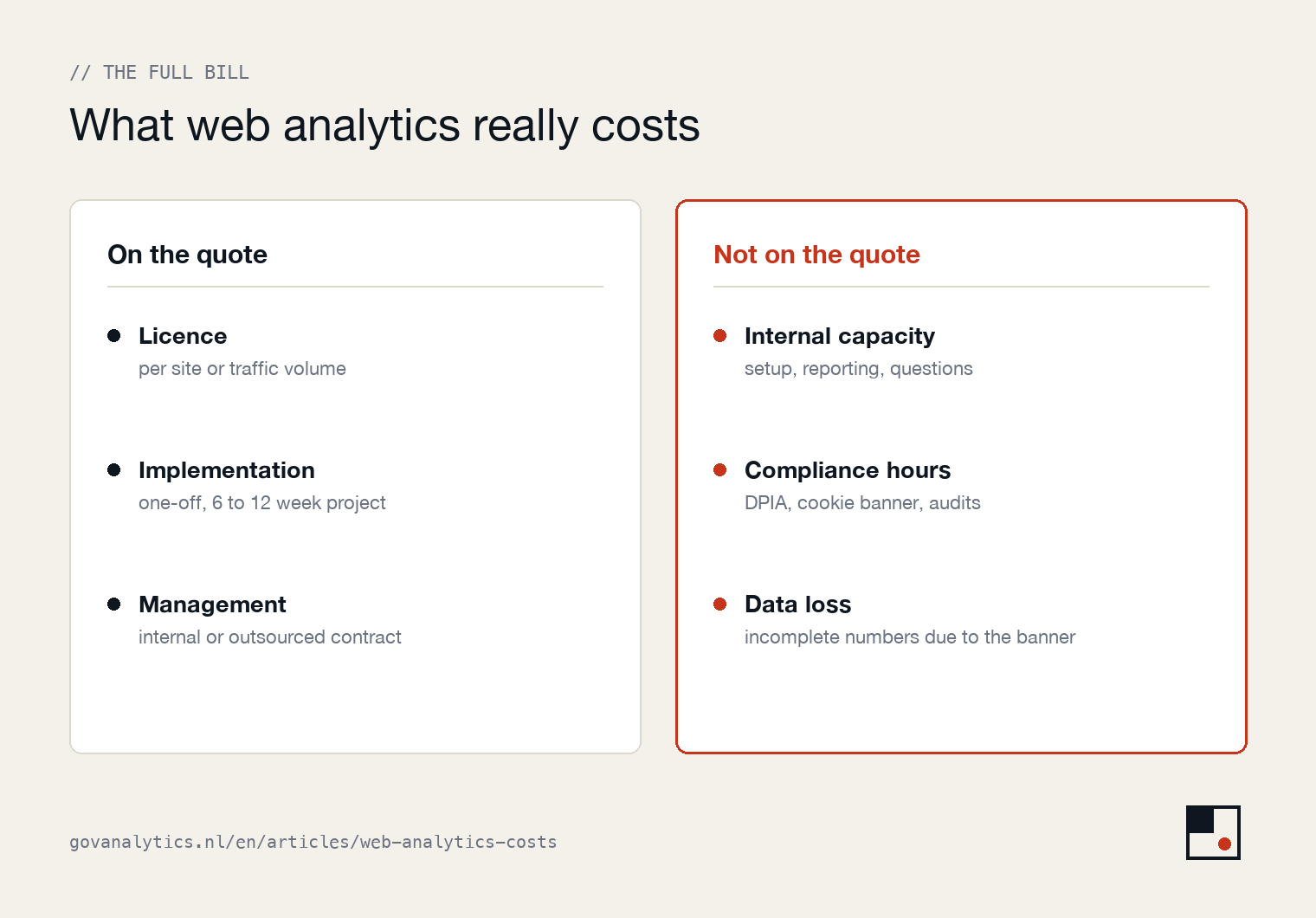
The three cost components of web analytics
Every serious cost comparison consists of the same three parts.
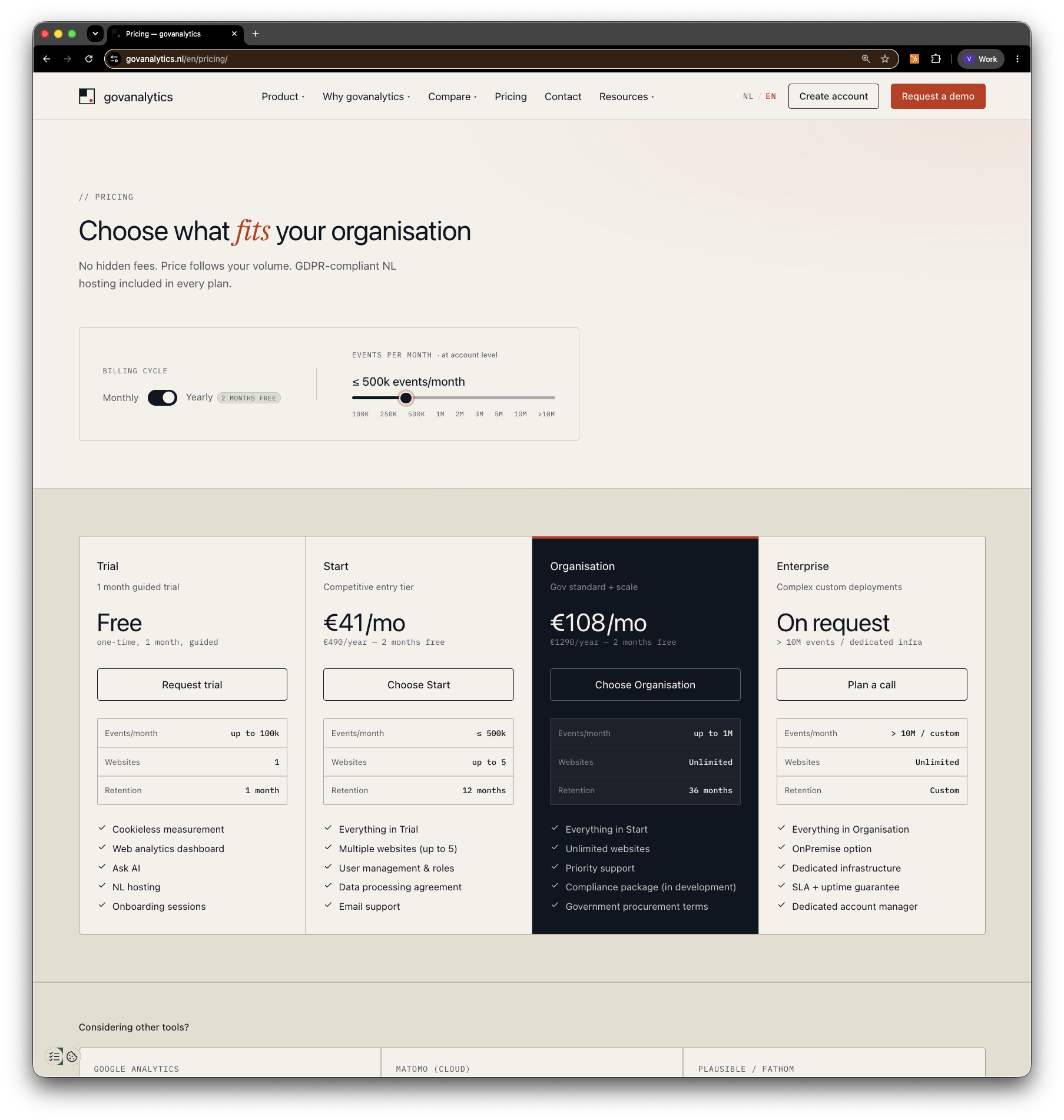
1. The licence. Privacy-friendly tools typically charge per site or per traffic volume. The range in the market is wide: from a few dozen euros per month for a small site to serious contracts for large multi-site environments. When comparing, check what the licence includes: with some vendors the cloud infrastructure comes on top, with others it is included.
2. The implementation. One-off costs: migrating tags, configuring goals, building dashboards, and running in parallel with the old tool to validate the numbers. A realistic implementation for a municipal website takes six to twelve weeks. Tools that support the GA4 tracking protocol reduce this item considerably: existing tagging keeps working and the migration is limited to changing where the data goes.
3. The management. The structural item that is forgotten most often. Who looks at the reports, who answers the editorial team’s questions, who keeps the measurement healthy? That can be internal (capacity) or outsourced (a contract). Outsourced management ranges from a few hundred euros per month for basic reporting to six to eight thousand euros per year for a fully managed engagement at a mid-sized municipality.
What determines the price
Four factors decide where you land in the range.
The number of sites and the traffic volume. One municipal website is a different story from a main site plus twenty campaign and theme sites. Ask every vendor how multiple sites and peaks (a crisis, an election) are charged.
The hosting choice. Managed cloud in the Netherlands, self-hosting in your own infrastructure, or data straight into your own data warehouse: each variant has a different cost profile. Self-hosting looks cheaper but moves the costs to your own operations team.
Doing it yourself or outsourcing. The cheapest tool that nobody looks at is more expensive than a managed contract that actually delivers steering information. Count the internal hours honestly.
The compliance starting position. A tool that measures without personal data by default keeps the DPIA short, makes the analytics cookie banner unnecessary and turns the annual audit into a formality. That difference is hard to capture in euros but very concrete in hours.
Costs and procurement
For public sector organisations there is a fourth dimension: how the contract gets through procurement. Below the European thresholds a limited tender procedure can suffice; above them it becomes a full tender with all the lead time that entails. The annual contract value of web analytics stays well below those thresholds for most organisations, but do include implementation and management in the estimate. And ask vendors about existing framework agreements: buying through a framework saves months.
Where cookieless measurement lowers the bill
The biggest structural saving is not in the licence choice but in the architecture choice. Measure without personal data and you strike a series of cost items in one go: the DPIA becomes short and defensible, the analytics cookie banner disappears including its maintenance, the discussions with the data protection officer evaporate, and the measurement data is complete instead of dependent on consent rates.
At govanalytics that is the default configuration: cookieless, no personal data, hosted in the Netherlands, with the infrastructure included in the licence. Current amounts per plan are on the pricing page. For organisations that prefer to be fully taken care of, there is the managed route. What it costs and when it pays off is covered in the article on outsourcing Google Analytics.
Frequently asked questions
- What does Google Analytics cost for a public sector organisation?
- The GA4 licence is free, but the real costs sit in capacity (configuration, reporting, knowledge of the complex event model), compliance (DPIA, cookie banner, audits, legal risk) and data loss through the consent banner. Count those items and GA4 rarely comes out cheaper than a paid privacy-friendly alternative.
- What does a privacy-friendly Google Analytics alternative cost?
- The range is wide and depends on the number of sites, traffic volume and hosting choice. Beyond the licence, count on one-off implementation costs (a six to twelve week project) and possibly management costs: from a few hundred euros per month for basic reporting to six to eight thousand euros per year for fully managed service at a mid-sized municipality.
- Does web analytics need to go through a public tender?
- That depends on the total contract value over the term, including implementation and management. For most organisations web analytics stays well below the European thresholds, so a limited procedure suffices. Also ask vendors about existing framework agreements; that speeds up procurement considerably.
- What are the hidden costs of web analytics?
- The three most forgotten items: internal capacity for management and reporting, compliance hours (DPIA, cookie banner, audits) and data loss through consent banners. These items differ strongly per tool and often determine more of the total bill than the licence itself.
- Is self-hosting cheaper than a managed cloud service?
- On the invoice yes, in practice often not. Self-hosting moves the costs to your own operations: servers, updates, security and availability. It is the right choice for organisations with a strong infrastructure team and strict sovereignty requirements, not as a cost-saving measure.
Want to know where your organisation lands in the range?
In 30 minutes we work through your situation: number of sites, traffic volume, hosting preference and management model. You get an honest picture of the total costs, including the items that never appear on a quote.
Request a demo